
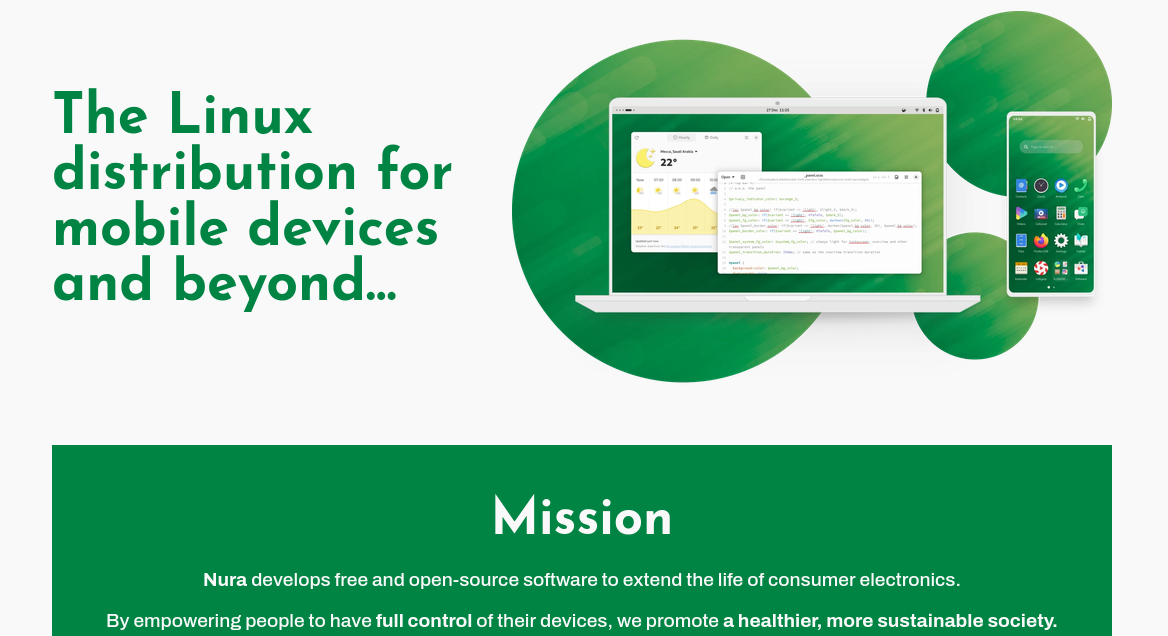
The mobile Linux distribution formerly known as postmarketOS has a new identity. On 27 September 2026, the project announced that it is now called Nura, closing an 18-month process that started with a simple problem: the old name had become harder to explain than the software itself.
The announcement was made at a community conference, and the old postmarketos.org address now redirects to the new home at nura.eco. For anyone who follows Linux on phones, it is the end of a long-running naming saga, and a signal that the project is thinking about a wider audience.
Why change a name that people already knew?
postmarketOS had a descriptive name, but not an easy one. It ran to five syllables, was frequently misspelled, and produced a cluster of capitalisation variants in articles, forum posts and package indexes. The project’s own team described outreach as an ongoing struggle, because every conversation began with explaining the name rather than the work.
There was a second issue: a purely descriptive phrase is difficult to protect as a trademark. The team also felt that “post-market” no longer captured what the project had become. What began as an experiment for running Linux on retired phones now has hardware partners such as PINE64 shipping devices with the operating system pre-installed. The project is less a post-market curiosity than a small but real mobile platform.
How Nura was chosen
This was not a rebrand handed down by a design agency. The project ran a community process:
- More than 300 name suggestions were submitted.
- A four-person selection team narrowed the list to four finalists.
- The community voted, and Nura finished with the highest score.
- The winning suggestion came from community member Davide Depau.
The name is short, easy to spell, and works across languages: the exact qualities the old name lacked. A trademark application has reportedly been filed.
What does “Nura” mean?
Nura is an abbreviation of Nuraghe, the granite tower structures built across Sardinia from roughly 3000 BC. They are distinctive, durable and tied to a specific place, which makes for a fitting metaphor for a project built around long-lived hardware.
The new domain uses the .eco top-level domain rather than .org. That is deliberate: the project frames its mission around reducing electronic waste by keeping usable phones in service. The shorter address also pairs well with the shorter name.
What changes for users
For most people running the distribution, very little changes at the technical level. The project remains Alpine Linux-based, and the work on device ports, mainline kernel support and mobile-friendly interfaces continues under the new banner.
Practically, you should:
- Update bookmarks from
postmarketos.orgto nura.eco. - Expect documentation, package and repository URLs to migrate over time; use the official site as the source of truth.
- Watch for the new name in release notes, package metadata and community channels.
What stays the same
The logo was not redesigned. It received a small refinement (more space between the arrows so it stays legible at a distance), but the mark remains recognisable. The community, the device support and the Alpine foundation are unchanged. This is a rename, not a reset.
Why it matters beyond one project
Naming is often treated as branding trivia, but it shapes whether a project can be found, cited and trusted. A name that is hard to pronounce creates friction in search results, podcasts and casual recommendations. For a niche platform trying to reach people who are not already Linux enthusiasts, that friction is expensive.
The move to Nura also reflects a shift in ambition. Mobile Linux has spent years being described as promising but impractical. Projects like postmarketOS/Nura have quietly built something more durable: a base that runs on real hardware, with partners who sell it. A clearer name is a small part of turning that work into something ordinary users can recognise.
If you have an old phone in a drawer, this is a good moment to look at the project again under its new name.
Sources: the Nura rename announcement, the postmarketOS name-change plan, and the OMG! Linux report that first flagged the change.